Project Profile
Catalina: New Development Rising from Below the Water Table
At a 260-acre development outside Valley, Nebraska, Valley Corp is producing the ground a new community will stand on, drawing more than a million cubic yards of sand from beneath a lake that does not yet exist.
Project Info
-
- Project: Catalina, a 260-acre mixed-use development
- Location: Valley, Nebraska, near U.S. Highway 275 and Meigs Street (about 25 miles west of Omaha)
- Owner and developer: Prominence Global, LLC
- Valley Corp’s scope: Overburden removal, dewatering, mass grading, and engineered fill, plus the underwater sand extraction
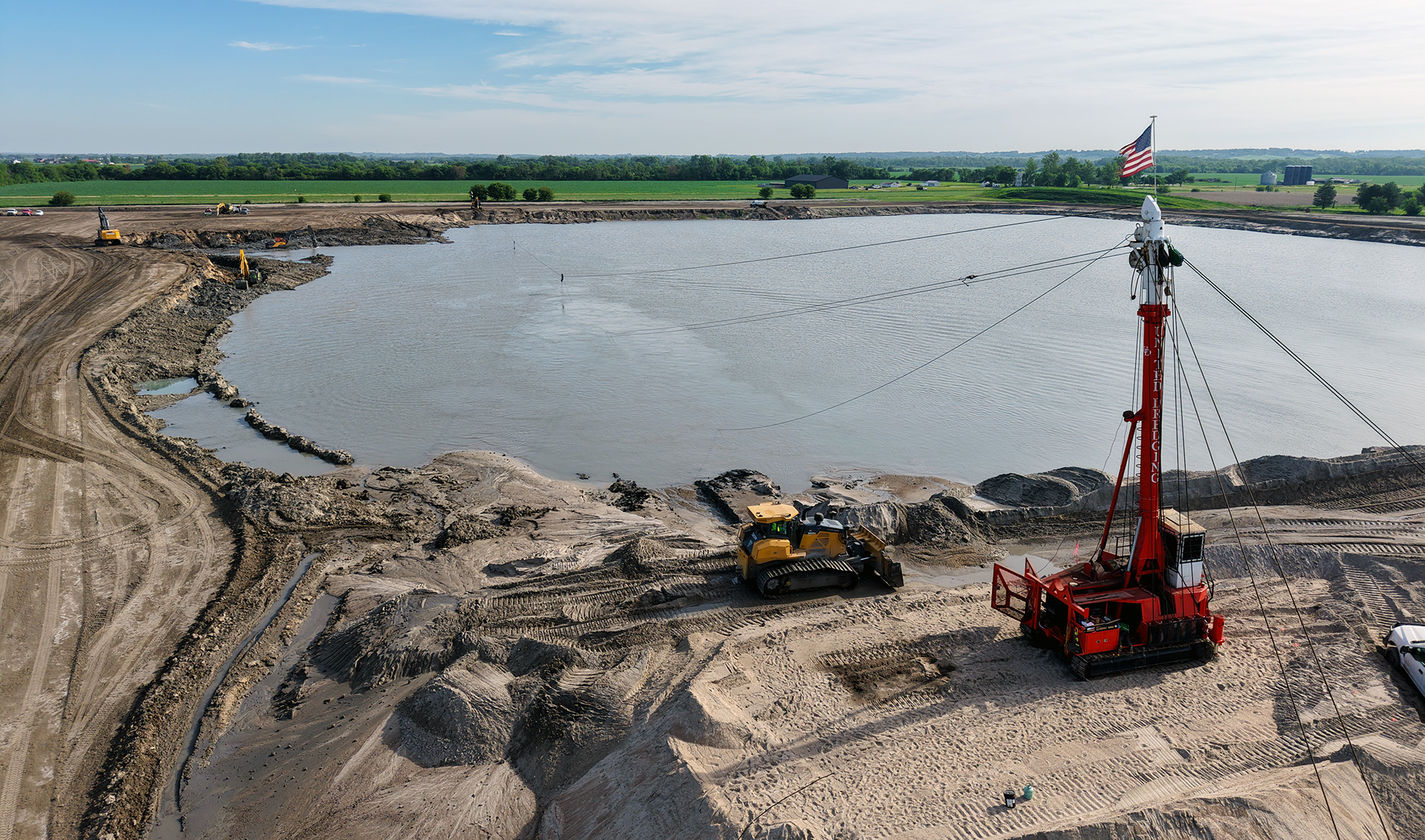
- Method: A skyline clamshell dredge with a 10-cubic-yard bucket
- Depth: 40 feet, roughly 20 feet of clay over 20 feet of sand
- Material moved: More than 1.1 million cubic yards across Phases 1 and 2
- Timeline: Started June 2025, wrapping fall 2026
Challenge to Reach Surface Material
On most sites, the structural fill is trucked in. At Catalina, it was already there, though roughly 40 feet down and in the water table. The sand this development is built on lies in a band between about 20 and 40 feet below existing grade, beneath a thick layer of clay, in ground where the water table sits close to the surface. Reaching that sand and shaping the void left behind into a designed lake is the core of Valley Corp’s work on the project.
By completion, the job will move more than 1.1 million cubic yards of material across the development’s first two phases.
Excavating in 2 Stages
The excavation advances from the top down, in two distinct stages:
-
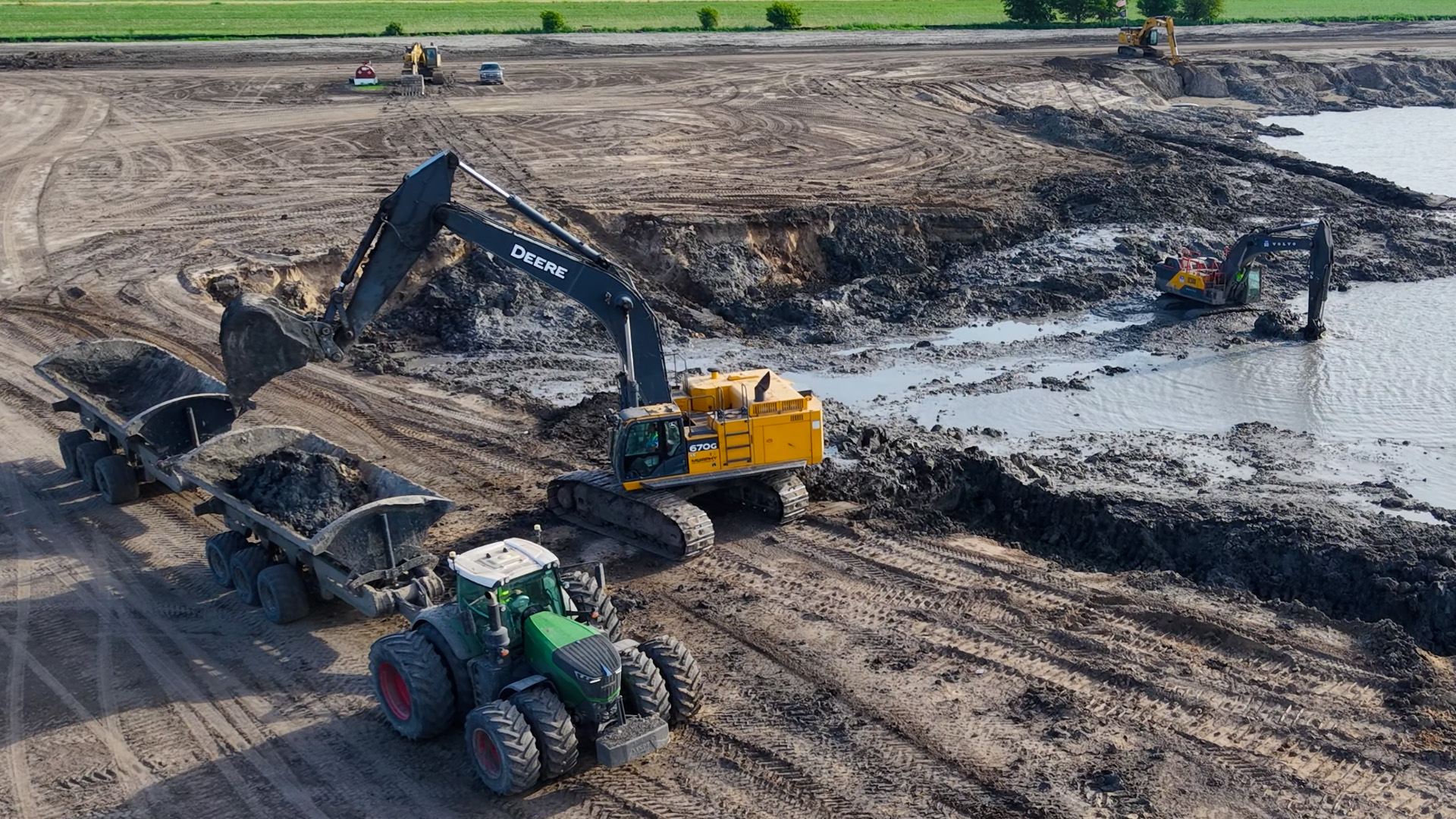
- The first stage is the clay overburden. Crews remove roughly 20 feet of it to expose the sand aggregate below. Because the water table is shallow across the site, the work depends on a sustained dewatering effort to keep the excavation dry enough for crews to advance safely toward the sand layers.
- The second stage is the sand, extracted from roughly 20 to 40 feet below grade. Rather than a floating hydraulic dredge, the project uses a skyline dredge: a 10-cubic-yard clamshell bucket suspended from a cable strung across the excavation. The bucket is lowered to the lakebed, closes on a load of sand, and is hoisted back to the surface, one controlled pass at a time. To the project team’s knowledge, it is the first application of this method in the area.
The complication is that the cut cannot be seen. It is entirely underwater. The operators work instead to GPS positioning, using a system called SmartPlan, and to bathymetric surveys that map the lakebed. Valley Corp interprets that survey data and relays it to the crew, who adjust each pass to hold the excavation to the design line.
The extracted sand never leaves the site. It is stockpiled, dried, then dozed and placed as engineered fill that raises the building pads for Phases 1 and 2. In effect, the project balances its own cut-and-fill. The sand drawn from beneath the water table becomes the ground the neighborhood will stand on, avoiding the need to import fill or haul spoil off-site. This is innovative and efficient.
Controlling the Slope
The governing risk on this work is slope stability. If the dredge undercuts the designed slope of the excavation, the consequence can surface years later as undermining or slope failure. The crew must therefore hold the underwater cut to its specified slope on survey control alone, without a line of sight to the work. Above the water, the same discipline applies through perimeter berms and a clear standoff between crews, equipment, and the open excavation.
The schedule compounded the difficulty. A significant share of the overburden removal occurred during a Nebraska winter, which meant dewatering in freezing conditions and stockpiling wet clay until it was dry enough to serve as engineered fill. Moisture conditioning of that kind is routine in principle and demanding in practice, particularly in January. The work also changed hands during that stretch, with one crew carrying it through the winter before a second took over early this year and continued to the same plan.
What this Site will Become
Upon completion of the massive effort to excavate, dry, and relocate the earthwork, this will become a very special part of the Valley, Nebraska community. The east side of Catalina will hold single-family and multi-family housing arranged around the new lake. The west side will be commercial, with retail, flex space, and room for future hotels.
Anchoring the development is the First Interstate SportsPlex, built in partnership with the Elkhorn Athletic Association, its first fields in use since 2023 and additional phases planned. One of those fields is barrier-free, designed for athletes who use wheelchairs or have sensory and adaptive needs, which speaks to the intent behind the development. Site Development will continue into fall of 2026 and spring of 2027.
Valley is among the fastest-growing communities in Nebraska, and Valley Corp has worked this ground for 54 years. Across the life of the job, a crew of 10 to 20 operators has read survey plots and run a clamshell by feel 40 feet below the surface, holding slopes that no one can see.
In time, families will move onto the lake and play on the fields, and the 1.1 million cubic yards of sand beneath them will go unnoticed. That is the measure of the work. Done well, future residents won’t even realize the massive amount of work it took to complete.
Project Photos | Click Image to Expand


